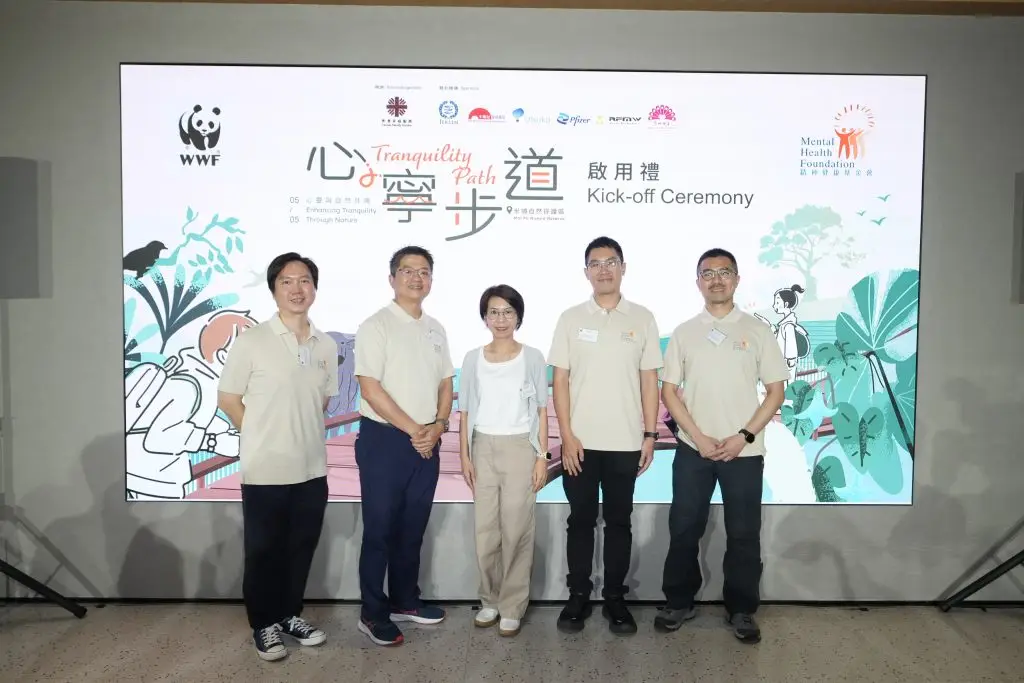
We sponsored the launch of “Tranquility Path”, a collaborative effort by the Mental Health Foundation and WWF-Hong Kong, introducing a serene pathway at the Mai Po Nature Reserve designed to enhance mental well-being through nature immersion. The initiative recognizes the increasing need for stress relief in today’s society and acknowledges the healing power of nature in promoting mental health.
Located near the Education Centre of the Mai Po Nature Reserve, the “Tranquility Path” features seven mindfulness practice checkpoints, including Mindful Breathing, Sensory Practice, Visual Practice, Auditory Practice, Sense of Touch Exercise, Mindful Walk, and Gratitude Practice. Participants are encouraged to slow down, engage their senses, and appreciate the present moment fully. Upon completing the exercises, participants can share their experiences, reflections and photos taken at the path, which will be compiled into personalized video to help reinforce this practice in their daily lives.
Through providing a space for individuals to unwind, we aim to help the individuals increase self-awareness, and improve their overall well-being through nature-based activities.
The “Tranquility Path” was officially launched on May 5, 2025. Learn more about the event here.
Nurturing the resilience of the next generation requires strengthening the multi-generational family dynamics surrounding them, moving from a child-only focus to a holistic family support network.
The Research Foundation:
Our youth strategies are grounded in evidence-based research by Hong Kong Shue Yan University regarding child-focused in-law relationship enhancement in multi-generational families. The study demonstrates that a child’s psychological and emotional wellbeing is highly related to their interaction with family members, particularly parents and grandparents.
It is crucial for children to learn positive family values at a young age.
Since 2016, the Foundation has established an annual family value theme, directly responding to the core pillars proposed by the Hong Kong Family Council: “Love and Care”, “Responsibility and Respect”, and “Communication and Harmony”.
To translate these values into daily action, the Foundation integrates Dr. Gary Chapman’s “Five Love Languages” framework (Words of Affirmation, Quality Time, Receiving Gifts, Acts of Service, and Physical Touch). LKKFF specifically champions the promotion of Quality Time and Words of Affirmation to encourage family members to express love through action:
Quality Time (Active Togetherness):
Concentration: Giving undivided attention to family members during interactions and conversations.
Get Together: Enjoying precious moments by bringing the family together to engage in activities of mutual interest.
Quality Dialogue: Paying close attention to body language and emotional expressions when listening to family members.
Be Expressive: Creating a safe environment that allows family members to confidently express their personal thoughts, feelings, and expectations.
Words of Affirmation (Positive Reinforcement):
Appreciation: Expressing clear gratitude to family members when they do something for the household.
Encouragement: Developing empathy by understanding the needs of family members from their perspectives, and offering vocal support whenever necessary.
Kindness: Learning to express deep care, empathy, and condolences within the household.
Humility: Communicating needs and requests with a humble, polite, and respectful attitude rather than demands.
Our framework recognizes that a family’s health depends on its capacity to perform essential functions, satisfy the diverse needs of its members, and interact constructively with its environment.
The Research Foundation:
Our approach adapts the conceptual framework of the Hong Kong Family Wellbeing Index (HKFWI) study conducted by the Chinese University of Hong Kong. To systematically elevate family wellbeing, the Foundation prioritizes initiatives that focus on improving the following six key domains derived from the index:
Family Solidarity: Enhancing mutual trust, appreciation, and emotional support, while fostering family harmony and quality time to build long-term resilience among members.
Family Resources: Fostering the growth of psychological capital, essential life skills, and safe home environments.
Family Health: Safeguarding and tracking both the physical and mental health conditions of the family unit.
Social Connection: Encouraging social involvement and empowering the family to contribute positively to the broader community.
Social Resources: Improving the accessibility of both informal support networks and formal institutional help.
Work-Life Balance: Creating strategies that mitigate the friction where work interferes with home life or home interferes with work.

(Note to Applicants: Funded projects are not required to apply all six domains simultaneously but must explicitly target and measure impact in at least one specific domain, and we would prioritize projects addressing the domains of the overlapping areas).
For further details of each domain, please browse at https://www.hkfws.org.hk/hkfwi/hkfwi-report (pp 41-43)